GENEROSITY

mugaisanghaNov 20
Kalpalata Lotus | Genshin Impact Wiki | Fandom
Pin on Animation stop motion

Dear Sangha

Xuansha said to the assembly, “Every teacher in the land talks of saving things and delivering humanity. When someone of three disabilities comes to you, how do you deal with that person? A blind person does not see you hold up the hossu; a deaf person does not hear your words; a dumb person will not talk no matter how much you desire it. How do you approach this person? If you cannot, Buddhism can bestow no benefit.” Blue Cliff Record, Case 88.

“Regard all life as a dream.” Diamond Sutra

Why do I bring these two quotes together? What is stirring within me, trying to emerge?

It has to do with Sangha, my friends. And our practice. Perhaps specifically our dream practice. We engage in dream-koan practice individually. And, for me more important, we engage in dream-koan practice as the Sangha. We share in each other’s inner lives. We share our most intimate hopes and fears and shames and joys and surprises and angers and greeds and ignorances. In entering into an embodiment of another’s dream, we not only have the opportunity to find some pearl in the depths of our own being, we also reach out our helping hands and hearts to the dreamer. We practice the wisdom and compassion of generosity. We give ourselves to another in need. The generosity of staying with incredibly difficult and penetrating feelings. This is not disappearing into the ghost cave of dead grasses in sitting meditation – while sitting meditation is truly important, it can be a life-sucking trap. We don’t treat the dream consciousness as a ghost specter, unworthy of attention. Giving ourselves fully into this practice, we enter completely the mystery of our True Face. Giving ourselves fully into this practice, we have the opportunity to enter completely into the mystery of Sangha.

We live within communities of (more than) three disabilities. Hungry people will not see us, even if we hold up a copy of the Lotus Sutra. Homeless people will not hear us, even if we chant the Heart Sutra. Abused people will not talk no matter how much we desire it. How do we approach these people? If we cannot, Buddhism can bestow no benefit.

We practice generosity of Sangha. In dream-koan, we practice helping each other. Helping each other with open, ragged, wounded hearts. Seeing and feeling and speaking our not-separation. We don’t pretend dull same-ness. We honor the no-separation evident even in our differences. Practicing thus, we have the opportunity to extend our generosity. Further and further. Deeper and deeper.

My daughter, who is a Family Medicine physician, called me this week. Her voice was cracking, and then she began sobbing. She had just been first person on scene of a single car accident. Father stumbling outside the car. Wife and daughter still in the car with multiple injuries. Son mangled and dead. She assisted the woman and their daughter until EMT’s arrived. And then tried to offer comfort to the father. My daughter was devastated. I did not suggest “All life is a dream.” I did not talk of “Form is emptiness and emptiness is form.” We stayed on the phone a long time. She cried. I cried. There is still a deep ache in my heart for this family that lost their son. And for my daughter. And for the EMT’s. Disability. Disability completely. Through and through.

Our practice is generosity, even in the most difficult situations. Generosity, even knowing that we share the disability of being unable to change anything. Can we practice allowing our hearts to break in dream consciousness, so that we may be able to open our hearts further in our most-ordinary lives?

8 Deep Bows

Zenho (auteur) & Issan

Noah’s Poem

I had a staring match with a baby on the subway today He started it  I said to the parents when they looked at me I sat outside in the cold  and watched the sunset reflect off the window of an empty storefront And I sat in my room and caught a glimpse of fear I thought about  Discontent And how I want to cry But for now I can only Shout  Or sit in silence Or walk  Or fight with my mind (and lose again) Or feel a tickle in my chest Last night it was anxiety This morning it was my  Heart

SCHEDULE 11/20-11/29

MONDAY, 6:30AM: ZAZEN (members with key, [may need to let yourself in)

MONDAY, 7PM, DREAM KOAN AT THE TEA HOUSE OR ZOOM

TUESDAY, 6:30AM, Zazen (members with key, may need to let yourself in)

WEDNESDAY, 6:30AM: ZAZEN AT THE TEA HOUSE OR ZOOM

THURSDAY, 6:30AM: ZAZEN AT THE TEA HOUSE OR ZOOM

         DOKUSAN WITH ISSAN SENSEI

FRIDAY, 6:30AM: ZAZEN AT THE TEA HOUSE

         DOKUSAN WITH ZENHO SENSEI

Rohatsu Zazen Schedule at the Teahouse

Nov. 30-December 8

Nov. 30, Wednesday, 6:30AM 

Dec. 1, Thursday, 6:30AM 

Dec. 1, Thursday, 6PM-8PM 

Dec. 2, Friday, Dec. 2, 6:30AM 

Dec. 2, Friday, 6PM-8PM

Dec. 3, Saturday, 6:30AM-11:30AM

Dec. 4, Sunday, 6:30AM-11:30AM

Dec. 7, Wednesday, 6:30AM 

BODHI DAY. Dec. 8, Thursday, 6:30AM 

We will interweave Heart Sutra and Identity of Relative and Absolute.

Authenticity

I’ve been reflecting on Authenticity recently.

There’s a lot of noisy chatter about Authenticity in the pop-psycho-business world. I think they’ve got it all wrong. Just my opinion, as Bernie Glassman Roshi says.

I spent a lot of time my first year as a Prep-school teacher working on a “groundbreaking” authenticity program. It was led by a brilliant and creative mentor of mine named Patricia Work (Sublette). Most of it was really intriguing and effective.

We think of Authenticity as that which is genuine, not fake. There are many socio-cognitive theories these days about what it means to be Authentic, and if one can actually be so. There’s the idea of recognizing “my true self”, but how can we do so when that so-called “true self” is something that is always in flux, constantly changing, both situationally and internally? I don’t buy it, because then it becomes “situational authenticity”, which is, well, calculated, fabricated. Seems like they’re trying drive a nail into an ocean wave.

Considering this brought up the 23rd Case in the Wumen-kuan (Gateless Gate) entitled “Think Neither Good Nor Evil”. There’s a good back-story as well, which I won’t get into now, but check it out sometime…please. As you probably know, the sixth Patriarch was being pursued by monk Myō ( an illiterate and lowly kitchen worker) who was after the robe and the bowl that signified transmission of leadership in the monastery. The patriarch laid the bowl and robe on a rock and said “This robe represents the faith. How can it be competed for by force? I will allow you to take it away.” Myō tried to lift it but was as immovable as a mountain. Terrified, he said “I came for the Dharma, not the robe. I beg you please reveal it to me.” The patriarch said; “At the very moment you were chasing after me without thinking good or evil, what was the primal face of Monk Myō?” At that instant Myō attained great realization. He said; “Besides the secret words and secret meaning you have revealed to me is there anything deeper yet?” The patriarch said; “What I have now preached to you is no secret at all. If you reflect on your own true face, the secret will be found within yourself.”

Easy, right? Not so much!

Perhaps what the patriarch was saying is “reflect on your own true nature, your Original (primal) Face.

Walking in a snowstorm during a Rohatsu sesshin, I asked my dharma brother Ryushin, “What does it really mean to practice the way? He said to me; “Shit like a monk! When it’s cold, be cold. When it’s hot, be hot. When you’re mad, be mad. When you’re happy be happy.” He was telling me; be authentic. No worrying about stuff, no analyzing the thinking (stinking-thinking!), just walking, eating, sleeping, shitting. I figured he was referring to “the observer” in my head finally going away. That wasn’t it! I somehow knew it was something else, deeper than that. I sat zazen with his words for that week and ultimately saw; What you reveal can only be revealed by you. What he said brought me to the realization of Maha (no outside, no inside), the all encompassing-ness of the Dharmahatu. The Primordial Ground of Being. It cannot be made hotter, or colder, happier or sadder, or made to stink less, even by enlightenment. It can’t be altered in any way, not even by practice or realization. Knowing it, what I saw when I looked in the mirror; my original face.

Rohatsu Zazen Schedule at the Teahouse

Nov. 30-December 8

Nov. 30, Wednesday, 6:30AM

Dec. 1, Thursday, 6:30AM

Dec. 1, Thursday, 6PM-8PM

Dec. 2, Friday, Dec. 2, 6:30AM

Dec. 2, Friday, 6PM-8PM

Dec. 3, Saturday, 6:30AM-11:30AM

Dec. 4, Sunday, 6:30AM-11:30AM

Dec. 7, Wednesday, 6:30AM

BODHI DAY. Dec. 8, Thursday, 6:30AM

We will interweave Heart Sutra and Identity of Relative and Absolute.c

SCHEDULE 11/13-11/19

MONDAY, 6:30AM: ZAZEN (David)

MONDAY, 7PM, DREAM KOAN AT THE TEA HOUSE OR ZOOM

TUESDAY, 6:30AM, Zazen (Madison)

WEDNESDAY, 6:30AM: ZAZEN AT THE TEA HOUSE OR ZOOM

THURSDAY, 6:30AM: SADHANA AT THE TEA HOUSE OR ZOOM

         DOKUSAN WITH ISSAN SENSEI

FRIDAY, 6:30AM: ZAZEN AT THE TEA HOUSE

         DOKUSAN WITH ZENHO SENSEI

Here’s our poem, given by Zenho this week:

Warm November

Sunray (?Sunra?) taking

A microsomething longer

As if on Holiday

To warm the fur

Yearling Doberman

Slurping whipped cream

From cuphand

Proffered by 8 year Old

Boy deeply loving this 

Pup sitting aquiver

Hearing this sunray

Tasting the warmth

And cool whipping

Bathing in this loving

Each for the other.

500,000

Are homeless tonight.

252 needle spike deaths

Each day

Dulling the screaming ache

Where there used 

To be

Sunray…and

Whiiped cream…and

Puppy fur…and 

8 yo boy/girl love.

Regardless of 

Giving Life

Or Taking away

Life

Manjusri’s sword

Cleaves this heart

Again.

Stonehouse

I really like The Mountain Poems of Stonehouse, translated by Red Pine. Jitsudo Roshi turned me on him. I have an old and beautiful hand-bound copy published in 1962 (second edition) by Empty Bowl. Stonehouse, 1272-1352, was a zen monk, poet, whom abandoned the monastic life and the “red dust of society” to become a hermit in the Tien Mu Mountains. When he arrived in the mountains he met Master Kao-feng. The master asked his reason for coming and Stonehouse replied, “I’m looking for the Dharma.” The master said, “The Dharma isn’t that easy to find. Your’ve got to burn your fingers for incense!”. Stonehouse responded, “I see the master with my own eyes. How could the Dharma be hidden?” The master nodded his approval.

There are a few wonderful stories about Stonehouse who became greatly respected as a master, though he refuted all accolades. Stonehouse “passed-by all places where there’s a buddha and he passed-by all places where there was no buddha.” He lived freely, unencumbered, simply on his own labors, and breathed in the mountains, birds, rocks, clear streams, hunger, the clouds, storms, tigers and monkeys, taro, pine, moss and cliffs as Dharma. He realized the Dharma by not approaching it but by being approached by it.

The Dharma indeed seeks us. Quiet down and be one with it as it is. No recognition, no practice, no sutras, no Buddhas, no temples, no religions, no gurus…MU. Exactly like zazen, just sitting. Stonehouse abandoned it all, all the teachings and trappings of spiritual materialism and just lived. His just living was an expression of the, always- Dharma. Thank goodness he left us a book of poems!

#44

I searched creation without success

then by chance found this forested ridge

my thatch hut cuts through heaven’s blue

a moss-slick trail through dense bamboo

others are moved by profit and fame

I grow old living for zen

pine trees and strange rocks remain unknown

to those who look for mind with mind.

Available on Amazon or Copper Canyon Press.

https://www.coppercanyonpress.org/books/the-mountain-poems-of-stonehouse-by-stonehouse-tr-bill-porter-red-pine/

SCHEDULE 11/6-11/12

MONDAY, 6:30AM: ZAZEN AT THE TEA HOUSE

MONDAY, 7PM, DREAM KOAN AT THE TEA HOUSE OR ZOOM

TUESDAY, 6:30AM, ZAZEN AT THE TEAHOUSE

WEDNESDAY, 6:30AM: ZAZEN AT THE TEA HOUSE OR ZOOM

THURSDAY, 6:30AM: SADHANA AT THE TEA HOUSE OR ZOOM

         DOKUSAN WITH ISSAN SENSEI

FRIDAY, 6:30AM: ZAZEN AT THE TEA HOUSE         

DOKUSAN WITH ZENHO SENSEI

Tuesday is a lunar eclipse, and auspicious time to recite the Samantabhadra Prayer. It is also a full moon and Election Day.

Here is Noah’s poem this week:

Yesterday, as I walked on the sidewalk

under golden leaves 

I thought about perfection

And this impulse to always be in practice

And how I want to be like the gods slash okay not being like the gods (either one is fine)

And the moon has been calling to me as well

She peeks out from behind buildings and clouds yearn to touch her

And she had me climb the fire escape to my roof last night

Yesterday, I talked to my friend Ma’moon, who is from Lebanon, where the moon is considered masculine

But tonight the moon is a woman

And I am her child 

And I am her lover 

And

There is a car alarm wailing below

But 

I speak 

to the moon

in silence

Deep Peace & Great Love,

Issan and Zenho

Zazen Mind

“The Way is basically perfect and all-pervading. How could it be contingent upon practice and realization? The Dharma-vehicle is free and untrammeled. What need is there for man’s concentrated effort? Indeed, the Whole Body is far beyond the world’s dust. Who could believe in a means to brush it clean? It is never apart from one right where one is. What is the use of going off here and there to practice?

And yet, if there is the slightest discrepancy, the Way is as distant as heaven from earth. If the least like or dislike arises, the Mind is lost in confusion. Suppose one gains pride of understanding and inflates one’s own enlightenment, glimpsing the wisdom that runs through all things, attaining the Way and clarifying the Mind, raising an aspiration to escalade the very sky. One is making the initial, partial excursions about the frontiers but is still somewhat deficient in the vital Way of total emancipation.

Need I mention the Buddha, who was possessed of inborn knowledge?—the influence of his six years of upright sitting is noticeable still. Or Bodhidharma’s transmission of the mind-seal?—the fame of his nine years of wall-sitting is celebrated to this day. Since this was the case with the saints of old, how can men of today dispense with negotiation of the Way?

You should therefore cease from practice based on intellectual understanding, pursuing words and following after speech, and learn the backward step that turns your light inwardly to illuminate your self. Body and mind of themselves will drop away, and your original face will be manifest. If you want to attain suchness, you should practice suchness without delay.”

-Dogen

When we practice zazen, especially at the outset, we bring with us this thing we refer to as “ourself”, the “I am”. This is the self that exists in our thinking activity. This self thinks that zazen has something to do with controlling thinking, controlling our mind. It thinks that trying “stopping thinking” will result in enlightenment. But that “self” that you bring to zazen has nothing to do with zazen. It cannot think itself into awakening, peace, enlightenment or bodhichitta. Actually, there is no-thing that needs to be done with the mind. Zazen mind is mind “as it is”. As Dogen says; “Suchness”.

Zazen is not a cure for difficulties, evils and discomforts. There are times when the practice of zazen is nearly impossible to tolerate because of pain, frustration or boredom. The frustration we experience is just “I am” mind grasping for yet another preference that we take up like a battle flag hoping to triumph and gain ground, yet feeling that somehow we are lacking in our pursuit. During these times it is helpful to relax and remember our Buddha-self, recognize the inseparable nature of our-true-selves and our buddha-nature and lovingly guide ourselves, slowly and gently back to the cushion. It is helpful to remember that no-thing needs to be done, no-thing needs to be remediated, no-thing needs to be changed. We simply need to sit comfortably on our cushion and breathe.

When we focus on our breath, allowing the mind the distraction it initially requires, we can then lightly become aware of the distractions produced by the “I am” thinking mind. The breath guides us into the connection of heart-oneness, wordless Buddha consciousness. This in itself is awareness. Upon noticing the “I am” mind we neither reject or embrace it. By simply by noticing that its nature is emptiness, we are engaged in cognitive awareness. The more frequently we practice this, the more easily we gain stability in zazen-mind. The most accomplished practitioners are the ones who have recognized these “I am” generated thoughts as mundane distractions and allow them to dissipate completely.

There is no merit, no wisdom and no gain in practice. We practice because dogs wag, fish swim, birds fly. We practice because we are enlightened.

A student asked Taizan Maezumi: “What is enlightenment?”

Maezumi replied, “Enlightenment is an accident.”

The student questioned, “Then why do we sit zazen?”

Maezumi replied, “Because it makes us accident prone.”

May our zazen effortlessly encounter happiness, peace and the light of our true nature .

Deep peace, great love,

Issan & Zenho

PS: No Dream Koan this week…see schedule below.

Here’s Noah’s poem:

Some days I arise into ceremony

My cushion awaiting 

My going forth 

But other days

Those other days

When I wake up later than I planned

When the taste of self-pity

is addicting 

Like the hand-rolled cigarettes I smoke on my stoop 

I seem to forget that I ever knew what faith was 

And perhaps I don’t 

But I do know that the sun will bloom into evening

And the exhaustion of the day

Will taste better than self-pity 

And I will sleep 

And dream

SCHEDULE 10/23-10/29

MONDAY, 6:30AM: ZAZEN AT THE TEA HOUSE

TUESDAY, 6:30AM, ZAZEN AT THE TEA HOUSE

WEDNESDAY, 6:30AM: ZAZEN AT THE TEA HOUSE OR ZOOM

THURSDAY, 6:30AM: SADHANA AT THE TEA HOUSE OR ZOOM

         DOKUSAN WITH ISSAN SENSEI

FRIDAY, 6:30AM: ZAZEN AT THE TEA HOUSE

         DOKUSAN WITH ZENHO SENSEI

Awareness

Our basic nature, our natural state, is awareness; emptiness and cognizance, indivisible.

No matter if we are a deluded sentient being or a buddha our essential nature is the same. The difference is knowing. When we first begin our practice, we are deep in conditioned thinking, assumptions, cleverness, ego and intellect. This is actually an enlightened state as it is the part of the whole, the beginning of the journey. This is where and how we begin to recognize our conditioning and resolve to enact change through practice.

At some point in our practice, maybe through an interaction with a teacher or another sangha member maybe when we’re in deep zazen or working with a dream/koan, we experience a small kensho (realization). Could be anything, really, and right there we catch a glimpse of our natural state. “What’s THAT?!” we wonder. It may be delicious, scary, boundless, relaxed. Like a huge, totally relaxing exhalation.

But as the Sandokai says, “Encountering the absolute is not yet enlightenment.” Merely recognizing our natural state is not enough. Each of us must practice, slowly gaining stability in our recognition of our natural state, and slowly, like good habit, we recognize it more frequently, more readily. It’s always there but we are habitually distracting ourselves with our thoughts, assumptions, grasping, aversions, opinions, in short, our delusional thinking.

How do we practice realizing our natural state of Emptiness and Cognizance? This is not the result of using the mind to purse a result. Doing so will only result in more cleverness, more conditioned thinking, more assumptions and ultimately, greater delusion. Remarkably enough, there is a liminal yet numinous thread, that need not, cannot be grasped at, but only gently noticed. Ah ha! We sense it. We practice recognizing it, we become aware of it as our natural state, thoughtless and perfectly at ease. Aware of it! Like a light warm breeze on your cheek, the caress of a leaf as you walk in the forest, the fleeting scent of Earth’s perfume on the wind, something barely noticed, ephemeral. It appears. That’s it! When we notice this, just notice it, it becomes slightly stronger each time, gaining stability in us. Little by little we begin to realize through practicing that it’s always there. We begin to be able to rest into it. Abiding in naturalness, dwelling in awareness. We are experiencing our natural state, Empty Cognizance.

As this stability increases so too does our experience and realization of Oneness. The connectedness of all being, sentient and insentient and our essential Buddha nature.

Padmasambhava said in the Lamrim Yeshe Nyingpo:

“Empty cognizance of one taste, suffused with knowing, is your unmistaken nature, the uncontrived original state.

When not altering what is, allow it to be as it is, and the awakened state is right now spontaneously present.”

SCHEDULE 10/16-10/22

MONDAY, 6:30AM: ZAZEN AT THE TEA HOUSE

MONDAY, 7PM, DREAM KOAN AT THE TEA HOUSE OR ZOOM

WEDNESDAY, 6:30AM: ZAZEN AT THE TEA HOUSE OR ZOOM

THURSDAY, 6:30AM: SADHANA AT THE TEA HOUSE OR ZOOM

         DOKUSAN WITH ISSAN SENSEI

FRIDAY, 6:30AM: ZAZEN AT THE TEA HOUSE

         DOKUSAN WITH ZENHO SENSEI

What a wonderful Cosmic Union ceremony for our sangha members Sebastiaan and Madison! Congratulations! We are so happy for you and wish you expansive joy and unfathomable love in your union!

Deep Peace, Great Love,

Issan and Zenho

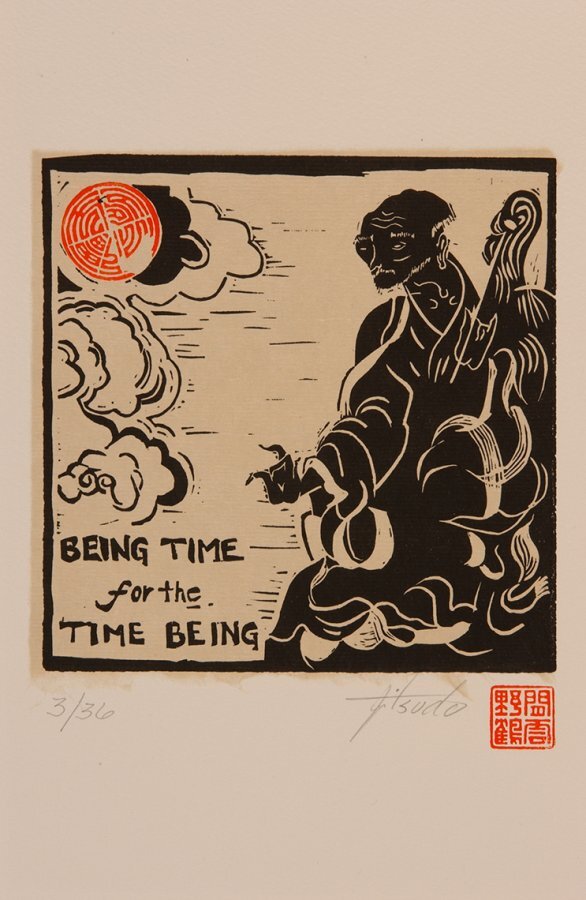
Being Time

woodblock print by Jitsudo Ancheta

Shōbōgenzō Uji (being-time) is Dogen’s experience of being (existence) and time.  Time, as we know it flows one way in linear fashion, marked by the hours of the day.  Time moves forward independently of our being, detached from our concerns, from an irretrievable past, through a momentary present, and proceeds to an unknown future. To think of time as only fleeting is to see ourselves separate from the Dharma and separate from the past, present and future. “

-Eidō Shimano Rōshi

Shōbōgenzō xx Uji

Words of an ancient buddha:

sometimes standing on the highest peak,

Being-time.

Sometimes going to the deepest ocean,

Being-time.

Sometimes three heads and eight elbows,

Being-time.

Sometimes eighteen or six feet high,

Being-time.

Sometimes a monk’s staff, a fly whisk,

Being-time.

Sometimes a pillar, sometimes a stone lantern,

Being-time.

Sometimes Mr. Chang, Mr. Li,

Being-time.

Sometimes the good earth and the vast skies,

Being-time.

-Eihei Dōgen

-Translated by Charles Vacher & Eidō Shimano Rōshi, excerpted from Shōbōgenzō Uji, ISBN#2-909-422-24-0, Pub. by Encre Marine

In December of 2012, having been in solitary zazen on the 6th day of Rohatsu, I noticed a mote of dust floating in a beam of winter sunlight pouring in my window. I couldn’t stop looking at it intensely. Upon experiencing that floating mote of dust I realized everything, everywhere has always existed all at once, as well as what I ridiculously call “myself”. At that moment the deeply engrained notion, the notion which had tethered me in countless ways, the delusion of time, dissolved completely for me. I knew in my marrow that what I thought about time was an immaterial, forged concept. I saw what I previously had called “time” was a deep interrelationship with all being, not just sentient being, but all being. If prajna is “the absolute nature (wisdom) of things as they are”, then the essence I was considering as “time” was empty sky, absolute zero, all encompassing. Then I had a funny thought, “It’s like everybody, everything, are all in the swimming pool at the same time always.” When I talked to Roshi about it in dokusan he just smiled a wry smile and said, “Being time, for the time being”.

Our teaching tells us that everything exists together simultaneously in any given moment. In our experience of dream consciousness (Saṃbhogakāya) we often realize a dissolution or warping of our static understanding of time. We move effortlessly through time and space, realities and conceptual realms, dissolving and reforming. If we pause and rest in natural awareness we experience this in our waking consciousness also; the “thoughtless moment” in our zazen.

Dainin Katagiri, (dai osho), says, “Dogen’s word being represents all sentient beings existing in the formless realm of timelessness, and time characterizes the existence of completely independent moments. Being and time work together, so Dōgen doesn’t separate them; he uses the one term being-time. Nothing has a fixed existence, so being must also be no-being. No-being means being disappears into the arising moment and becomes one with time. When being is time, being manifests as the particular forms of the phenomenal world, and time occupies the whole of space as the present moment.”

So, you see, being is time and time is being.

SCHEDULE 10/1-10/8

MONDAY, 6:30AM: ZAZEN AT THE TEA HOUSE

MONDAY, 7PM, DREAM KOAN AT THE TEA HOUSE OR ZOOM

WEDNESDAY, 6:30AM: ZAZEN AT THE TEA HOUSE OR ZOOM

THURSDAY, 6:30AM: SADHANA AT THE TEA HOUSE OR ZOOM

FRIDAY, 6:30AM: ZAZEN AT THE TEA HOUSE

         DOKUSAN WITH ZENHO SENSEI

So dear friends, until next time,

Being time for the time being.

Deep peace and great love,

Issan & Zenho

PS

Issan is out of town, Thursday-Wed.

Here’s Noah’s poem for us this week:

The season has begun to change

and I drive east

through a familiar land

I feel apart from 

Time tightens

as I try to figure out how to enter 

each moment

fully

The same themes emerge in my mind

the iron car traps my thoughts 

who is awake anyway?

the man sunken into his chair 

selling me the snickers bar at the gas station

the woman staring out the nighttime window

in the diner

the mechanic balancing my tires 

telling me that there is a way of seeing 

that emerges once the ego is cracked away

and what is it?

this wakefulness that I yearn for 

as the desert mountains 

become hills of grass

become forests of pines

become the 

ocean

Rohatsu 2022

Noah Seltzer, one of Zenho Sensei’s students is offering a weekly poem to the sangha.

Here is the poem for this week:

It turns out it is not what I thought it was

those mornings

traversing the excruciations of the mind 

would not 

ungrasp me 

that I would not figure it out 

find the solution 

after all

tear open the gates of this 

world 

to be let in 

at last

but instead 

I would have to let the revelation 

unfold me

unveiling herself like magic 

like that one day when I could finally 

finally!

see the sunset blooming into the evening after a day on the beach

and then sit 

and let the lyrics of the morning light

soften my 

seat

Rohatsu is the Buddhist celebration of the Buddha’s enlightnenment after sitting beneath the Bodhi tree for 8 days. It begins on December 1 and ends on Bodhi Day, December 8, it is the day Siddhartha opened his eyes, saw the morning star, touched the earth and said at the moment of the his enlightenment, according to the Avatamsaka Sutra (or Flower Garland Sutra),“I now see all sentient beings everywhere fully possess the wisdom and virtues of the enlightened ones, but because of false conceptions and attachments, they do not realize it.”

In Zen Buddhism, Rohatsu is customarily preceded by a sesshin, a weeklong retreat involving intensive meditation. One the eve of Rohatsu, practitioners often meditate through the night in recognition of Shakyamuni’s all-night vigil culminating in his enlightenment. Rohatsu is the most important sesshin of the year.

As much as we might like to offer a week long sesshin for Rohatsu we realize that most could not participate due to our lay commitments..

This year for Rohatsu sesshin we would like to propose the following schedule:

December 2, Friday evening: 7-9PM

December 3, Saturday: 6:30AM-7PM

December 4, Sunday: 6:30AM-7PM

December 8, Thursday, Bodhi Day: 7PM-9PM

Please prioritize participation for the full program if at all possible. It is an important time for us to be together and to be supporting one another’s practice. We would appreciate the input of all sangha members regarding this schedule so we can make it work for as many of members to participate for a s much as possible. Please let us know how this works for you.

A note on dana regarding sesshins, zazenkai and ceremony: Sangha members who participate in these events, celebrations and ceremonies are encouraged to make dana to the sangha/teachers. We have explored the reasons for dana in a previous post. The dana can be offered by sealing it in an envelope and leaving it on the altar anytime during the sesshin or ceremony.

Schedule 8/28-9/4

Monday, 6:30AM, Zazen at the Tea House

Tuesday, 7PM, Dream Koan at the Tea House or ZOOM

Wednesday, 6:30AM, Zazen at the Tea House or ZOOM

Thursday, 6:30 AM, Vajrakilaya Sadhana, Tea House or ZOOM

Friday, 6:30 AM, Zazen at the Tea House or ZOOM

It was so amazing to be with you this weekend for zazenkai. So many beautiful awakenings manifested, challenges to our practice, good works done and the concentration of our hearts as one.

Thank you to all who attended!

Deep peace, Great love,

Issan & Zenho

What is Zazenkai/Sesshin

At Upaya, Santa Fe, NM

Sesshin is a period of time, usually ranging from 2 – 7 days, in which silence is maintained and the focus is on zazen. Sesshin is a cornerstone of Zen practice for which there is no substitute—it is essential for any practitioner who hopes to gain insight into their true nature.

Sesshin, while commonly understood as a Zen retreat, literally means to unite the mind. It is an opportunity to gather together one’s energy and concentrate it in order to clarify the great matter that is our life. We do sesshin as a group as the support that each person gives to the others is vital for a strong sesshin.” (Stolen directly from Upaya’s website)

Zazenkai is generally understood to mean a shorter session.

We encourage all sangha members, especially those preparing for Jukai or Tokudo, to attend the zenkai.

Zazenkai Saturday 8/27-Sunday 8/28Schedule

Saturday 8/27/22

         6:30-7:00            Zazen

         7:00-7:10            Kinhin

         7:10-7:40            Zazen

         7:40-8:10            Council: Taking Refuge

                                    What is the personal meaning

         8:10                    Heart Sutra

         8:20                    Breakfast

         9:00-9:30            Zazen

         9:30-9:40            Kinhin

         9:40-10:40          Samu

         10:40-10:50        Kinhin

         10:50-11:20        Council: 3 Pure Precepts

                                    What is the personal meaning

         11:20-11:50        Zazen

         11:50                  Identity of Relative and Absolute

         12:00                  Lunch

         1:00-1:30            Zazen

         1:30-1:40            Kinhin

         1:40-2:10            Zazen

         2:10-2:20            Kinhin

         2:20-2:50            Council: Bowing, ritual

                                   What is the personal meaning

         2:50                    Shin Shin Ming

         3:00                    Break

         4:00-4:30            Zazen

         4:30-4:40            Kinhin

         4:40-5:10            Zazen

         5:10-5:20            Kinhin

         5:20-5:50            Council: 10 Grave Precepts

                                    What is the personal meaning

         5:50                    4 Bodhisattva Vows

Sunday 8/28/22

         6:30-7:00            Zazen

         7:00-7:10            Kinhin

         7:10-7:40            Zazen

         7:40-8:10            Council: Feminine Buddha

                                    What is the personal meaning

         8:10                    Heart Sutra

                                    Green Tara Sadhana

         8:30                    Breakfast

         9:10-9:40            Zazen

         9:40-9:50            Kinhin

         9:50-10:40          Samu

         10:40-10:50        Kinhin

         10:50-11:20        Council: Masculine Buddha

                                    What is the personal meaning

         11:20-11:50        Zazen

         11:50                  Identity of Relative and Absolute

                                    Vajrakilaya Sadhana

         12:00                  Lunch

         1:00-1:30            Zazen

         1:30-1:40            Kinhin

         1:40-2:10            Zazen

         2:10-2:20            Kinhin

         2:20-2:50            Council: Sangha

                                    What is the personal meaning

         2:50                    Shin Shin Ming

SCHEDULE 8/21-8/27

Monday 6:30am Zazen at the Tea House with Madison opening

Tuesday 6:30am Zazen at the Tea House with Madison opening

Tuesday 7pm Dream Koan at the Tea House or ZOOM

Wednesday 6:30am Zazen at the Tea House of ZOOM

Thursday 6:30am Green Tara Sadhana at the Tea House or ZOOM Dokusan with Issan Sensei

Friday 6:30am Zazen at the Tea House or ZOOM and dokusan with Zenho Sensei.

Deep Peace & Great Love,

Issan & Zenho

Vows

Greetings!

First, I’d like to comfort you and address your concerns about Jukai and the timing thereof. I sincerely regret if I have created a feeling of anxiety in anyone by my incomplete communications. Zenho and I are planning to do a Jukai Ceremony, hopefully for a few folks together, whomever feels ready, in January 2024. If anyone feels ready and wishes to have ceremony before then, please talk to us to make arrangements. There’s no hurry! If January is not a good time for you, that’s OK! We are committed to having this be a deeply meaningful experience for you, whenever you and your teacher decide to take this step. Take your time, understand what you’re taking-up, sew your rakusu carefully and beautifully. Enjoy the ride!

Taking the vows of jukai are about becoming a Buddhist, officially. We take the vows of Refuge; in the Buddha, the Dharma and the Sangha which we’ve discussed in an earlier post.

What does it mean to make vows? “Ordinary people are those who live by being pulled by their karma (gosshō no bonpu): bodhisattvas are those who live led by their vows (gannshō no bostsu)”, according to author of “Living by Vow“, Shohaku Okumura.

We also vow to uphold the precepts.

The Three Pure Precepts, which are principles prescribing a particular course of action or conduct, are thus:

1.Do not commit evil.

2. Do good.

3. Do good for others.

The Ten Grave Precepts are:

  1. Do not kill
  2. Do not steal.
  3. Do not be greedy.
  4. Do not tell a lie.
  5. Do not be ignorant.
  6. Do not talk about others errors and faults.
  7. Do not elevate yourself to put others down.
  8. Do not be stingy.
  9. Do not be angry.
  10. Do not speak ill of the three treasures.

Although these are phrased as absolutes, who could possibly embody all of these at any given time?! As Susan Murphy, Roshi suggests, (in my new favorite book, “Red Thread Zen“); “You have to hold yourself toward your precepts. All appropriate and fit responses flow naturally from that.” The vows make sure.

Life/practice are inseparable. Embracing and embodying “The Four Vows” that we say each evening; desires as inherent purity, and boundless dharma gates, we are affirming our practice of holding living lightly, open-handedly but with awareness and reverence.

Roshi Murphy again; “A vow asks that I hold myself toward life with awareness and respect, and in this way moves life in more intent direction that’s subtly but remarkably different from “just coping”. Not only each of your immediate relationships and actions but the wider, larger fate of humanity and the life of the world begins to live in you and to ask searching questions, beginning with Who is this? And what is it to become like this?”

How should we uphold the vows we make? “When Zhaozhou ws asked; “What is the fact for which we must bear responsibility? He replied, “Though you search to the end of time you’ll never single it out”.

And this; When a Chinese nun of great enlightenment was asked by a novice; “How do you keep all these precepts” (there are 311 for Chinese nuns), She replied; “I only keep one. I just watch my mind”.

In spite of our refinement, enlightenment, grace and radiance, we are still messy, muddy, flesh bags, foibles of humanity stumbling about doing the best we can. Knowing that, those of us with this beautiful and amazing powerful practice in our lives are moving into, not towards, but into our awareness of our already awakened buddha nature. Each action we take such as Jukai, each vow we make, each precept we embody in the way of the dharma enriches our experience.

Deep peace and great love,

Issan & Zenho

Other stuff: I will be heading to New Hampshire (the homeland of the most supreme maple syrup) for my 31st year at the Craftsmen’s Fair, August 2-16. I am grateful to Zenho for taking over this blog for the next couple weeks!

Zenho Sensei will be out of town, 8/3-8/13.

Don’t forget Zenkai Weekend August 27-28.

Schedule, 7/31-8/6

Tuesday: 7 PM, Dream Koan, at the Tea House zoom ONLY

Wednesday: 6:30 AM, Zazen at the Tea House with Mugen opening

Jukai

Together, let’s congratulate Victor on his recent Jukai ceremony!

Zenho Sensei has given him the name HuoHua NuHuo, which translates to “Fire Clears Anger”.

I am aware of quite a few of our sangha members who are currently or soon-to-be engaged in Jukai and Tokudo ceremonies. We are so very happy about this!

We hope to schedule some group study sessions for Jukai ceremonies which you are encouraged to attend. It is also very helpful to coordinate your rakusu sewing times and to form an occasional “sewing circle” when working on your rakusu. It was challenging for me and help was deeply appreciated. Some sangha members are accomplished at this type of work. The job of sewing your rakusu will yield unimagined benefits for you!

I would like to offer some upcoming posts on Jukai and the Precepts that are important understandings for us to hold as we move toward our ceremonies. I heartily recommend you read the ZCLA Jukai Seminar Workbook. If you’d like a copy please let me know.

Here is an introductory article by Diane Eshin Rizzetto about Jukai.

This is what Gempo Merzel, Sensei says in the Zen Center of Los Angeles Jukai Seminar Workbook:

“Jukai is a formal way of recognizing and being recognized as what we really are. It’s saying to the world, “Okay, I am taking the name and putting it on the rakusu and formally becoming a member of the sangha because I already feel it inside. I feel I’m already a person who’s following the path of enlightenment, and I want to formally recognize that commitment, that state of being, and have other people recognize it too.”

Jukai means; JU – To take, receive, accept. KAI – Precepts (in Sanskrit Sila).

To take Jukai is to reveal or embody the precepts.

We take these precepts and practice because we are enlightened.

Vows are a natural outgrowth of out desire to clarify and appreciate our life. Our own vows help to strengthen our practice and give us an opportunity to actualize our desire.

To study the precepts is a chance to study the cause and effect of our actions.

What are the steps to taking Jukai?

  1. Make clear your intentions to your teacher.
  2. Study the Jukai seminar workbook.
  3. Be as active in attendance and services (in person) as you possibly can. Make your commitment at this time to make your practice vigorous!
  4. Sew your rakusu (You can get the kit and instructions here from Liz Fox.)
  5. Discuss Jukai with your teacher and attend any training or study sessions offered.
  6. After your teacher has agreed to your Jukai and your rakusu is completed, ask about setting a date for your ceremony.
  7. There is Jukai dana that is made directly to your teacher.

There is a vibrant and loving energy about the sangha of late! It is so wonderful to feel this and we know that Jitsudo is smiling pleasantly as he observes our blossoming!

Deep Peace, Great Love,

Issan. & Zenho

Please make time for our ZENKAI weekend August 27 & 28.

Schedule, 7/24-7/30

Monday and Tuesday 6:30 AM: Zazen at the Tea House with Scott opening.

Tuesday: 7 PM, Dream Koan, at the Tea House or zoom

Wednesday: 6:30 AM, Zazen at the Tea House or zoom, with Zenho Sensei

Thursday: 6:30 AM, Vajrakilaya Sadhana, At the Tea House or zoom. Dokusan with Issan Sensei.

Friday: 6:30 AM, Zazen at the Tea House or zoom. Dokusan with Zenho Sensei.

Vast is the robe of liberation!