A monk asked Wind-Source Mountain: “Word or silence- either way you cross over into its all broken between Presence and Absence, the differentiated and the undifferentiated. How do I avoid that transgression altogether?
Master Wind-Source replied: I always remember, south of the river, that third month: mountain-partridge calling out, hundred blossom scents.
Are you approached?
Resting in silence. Nothing said, nothing done, no words spoken or sutras read, no teaching given, no beings as teacher or student and nothing other than the reality of flawlessly being the intimacy of heart-selfhood.
Or maybe using words? What’s the difference?
Don’t name it Zen, Dzogchen, Mahamudra or Vajrayana! Naming disappears in the actuality of intimacy of being. The ground of reality is no more or less than this. Even this speaking of it is saying too much.
Do you hear the partridge calling out?
Walking in the sunshine, breathing in the clear blue sky, knowing it is you and you are not anything you think you are, but this. There is no “just this”, no “that”. Fully as you are, as it is.
Do you smell the hundred blossom scents?
Selfdissolving, leaving it out of concepts. Feeling the roots of the mountain in your legs and the clouds in the sky; you, yourself are resolved into intimacy with the Ten Thousand Things.
Maybe not? Who cares?!
From The Tiklay Kunsel Tantra*:
“[The Zero-Dimension] has no root cause, is subject to no circumstantial conditioning and no possible recourse; it cannot change. It cannot be touched by ignorance, dogmatic assertion, atheistic denial, sloth or emotional affect. It cannot be stained by eternalistic or nihilistic belief, by limiting belief in existence or nonexistence by fixated dualistic materialism or any other dualistic argument.”
“The essence spun into elixir is the pure presence that is the nature of spaciousness.”
*The Circle of Total Illumination, 8th-9th century BCE
Deep Peace & Great Love, Issan (author) and Zenho Roshi
Schedule 3/25-4/2
Tuesday, Wednesday: 6:30 AM Zazen at the Teahouse, Andy opening
Thursday, 6:30 AM, Zazen at the Teahouse, Dokusan with Issan Sensei
Friday, 6:30 AM, Zazen at the Teahouse, Dokusan with Zenho Roshi and Issan Sensei
Throughout history monks and enlightened persons have left behind the distractions of the world and retreated to the mountains and rivers of the wild places. There they reveled in the unfolding of the natural world and in the ecstatic life of being fully engaged in reality, the clarity of realizing the integration of the world and themselves as one.
It seems like a dream! Most of us deal with the mundane reality of day to day living. But there is a glistening jewel in the midst of this mundane living and we may experience it whenever, wherever we want to.
What we see as objects and call experiences “out there”, out side of ourselves, is actually ourselves appearing as projection of mind. We are mostly unconscious of doing this and mistakenly call it “out there” or objectify it and separate ourselves from reality. This is creating separation. As we become adept at zazen, we begin to become aware of this and this idea/action begins to disolve. As that dissolution grows as integral to our view, pure awareness arises. This is a primary aspect of emptiness.
The experience of our original nature, our pure nature, is distorted by the filter of intellectual “understanding”. A vague feeling of separation from our true nature arises as an emotional sense of free-floating uneasiness, restlessness, a sense of being unsatisfied. When we practice zazen well, we pierce the veil that creates separation and as it dissolves we relax naturally into our true selves, experiencing the “not-two” of our original nature.
When the veil blocking our clarity drops away we have a view of ourselves in the mirror of consciousness. We see “ourselves” as we actually are; constant movement, constant change, nothing stagnant, like a flowing emerald stream, like the moonlight on Cold Mountain. Dualistic conceptualization fades away; stillness and movement become one and the same. When we recognize our ideas of us-and-them, me-and-you, this-and-that as our erroneous, self-centered, personal mythology, those mental constructs drop away quite naturally.
Purity of mind is our easily recognizable natural state. It’s the same inseparable state of being that Gautama Buddha realized. He didn’t create it, he just recognized it, transcending all self-doubt. The original mind is you and you are already the original mind. It is only thinking that separates you from the reality of it. When a Zen master laughs at everything it is the realization of original mind. When Han-shan writes of Cold Mountain’s magical illusions it is the realization of original mind. Isn’t it everything, no-thing?
When you open your eyes in the morning, pull on your shoes, drink your tea, drive your kid to school, make your art work, notice the cranes flying overhead, laugh, feel sadness, sate your hunger, engage with desires, feel pain, all of it, you are experiencing your original mind. Trying to eliminate, or refine the original mind is what veils it. Wholeheartedly embrace the experience of what is arising moment by moment with out mental manipulation, just seeing it, this is the glistening jewel.
It’s just not necessary to entangle your mind by clinging to ideas that there is some enigmatic goal to achieve or an evaluation that needs to be done, or that you are not what you should be, or what you want to be, or what you need to be, or what someone told you to be; when mind is entangled the clarity of life that is available to you, right before you, right now, is overlooked.
Every breath is an offering, an opportunity to “touch life” as Thich That Hahn said. Breathing in awareness, breathing out compassion for all beings. This is the practice of being awake. This has always been the practice of all Buddhas and bodhisattvas. So simple. Always available to us. Together each of us can clearly experience our original, pure nature by seeing what is and knowing it’s you; knowing it’s you and seeing what is.
This is dwelling in Han-shan’s still world.
Han-shan
SCHEDULE 1/28-2/3
Issan and Zenho are out of town Monday-Thursday this week.
Tuesday, Wednesday, Thursday: 6:30 AM, Zazen at the Teahouse, Andy opening
Friday: 6:30 AM, Zazen at the Teahouse, Dokusan with Issan Sensei
NOAH’S POEM
This winter
Brings weeks of rain
I step shyly
Into puddles on the blacktop
This winter brings
Days of snow
And I slide
With caution on leftover ice
The plants are healthy by the train tracks in the backyard
And I listen to the heater’s hum and drink hot tea
And wrap myself in my humanness like a blanket
When I’ve exhausted myself from aspiration for the day
Koan: An older woman had been supporting a solitary monk living high up Just This Mountain for 25 years. She decided she wanted to get a sense of his attainment. She asked a beautiful young woman from the local village to pay the monk a visit. The young woman did so. When she returned the olddr woman asked “How is the monk.” The young woman related that the monk would not receive her into his hut, saying at a distance “Old pine. All branches withered and dry.”
The older woman was furious. She went to the hut and tore it down,. Driving the monk from the mountain she exclaimed “Such a charlatan. Do not waste any more of my time!”
Sitting upon our cushions, it is necessary for a time to say NO to thoughts. To stabilize Mind in our minds. Once done, it is important to explore how to say YES. This of necessity engages ethics, the eight-fold path, service, passion, and so much more.
Where do you find yourself upon the path? Where does the path meet you?
Why is it that we feel that we must bring meaning to our experiences? Can we simply experience them in their natural purity? We usually think about the experience as it’s happening, as we’re actually having it and try to remember it exactly, cling to it so we can later ruminate on it’s meaning and then determine how it places us in our social structure and self-concept. Usually we have some awareness that we’re doing this and we feel a bit uncomfortable because we don’t really want to be doing that! We would prefer to be fully present and get the most out of the experience. We have all observed the “selfie-syndrome” where the experience is taking place from a third person perspective, missing it completely, in a state of compulsive dissociation. A social media monster.
Are we missing the experience entirely? Are we even capable of having an experience in its natural purity? We place experiences in a contextual structure that constantly creates the story about “me” in a meaningful way, as if to reassure ourselves of the validity and meaningfulness of our existence. Yet we cannot accurately remember an experience exactly. At the very moment the experience occurs, our mind processes it and it becomes a memory, colored with the hues and saturation that our minds unconsciously paints it with. Despite our best efforts to remember it clearly, we cannot. We remember what our mind tells us about the experience. Thestory, remembered in narritave thinking or feeling-tones, immediately emerges about the experience and reinforces the ideas we unconsciously hold about ourselves. It creates the meaning of our relationship to, and our place in, the self-conception of our being-ness and in how we fit into the world.
This “creative thinking” is referred to in koan as “stacking tiles on your head”. The ideas, conceptions and thoughts we compile, knowingly or unknowingly, are like foolishly stacking tiles on your head, eventually they tumble off with a great crash! The interpretations, concepts, ideas and stories we’ve embedded crumble, often causing great suffering, consternation and confusion. The very thing we erroneously cling to as meaning has proven to be a branch we are clinging to in mid-air as we are falling.
I would ask: Can we directly experience something without “stacking tiles on our heads”? What do you think? Which are the experiences that tend to snap you into the moment directly, without conceptual thinking? Are they the rapturous moments; sounds, colors, physical sensations, breath-taking landscapes? Have you had these openings in psychedelic induced moments when the self drops away and the clear, ecstatic presence of all-one-being-ness obliterates everything that had obscured the directness of experience of the as-it-is.
Have you experienced this dropping away, this falling off of tiles in your meditation or elsewhere in your life? The Mū koan is known to do this. Throughout different schools of Buddhism there are many methods, techniques and esoteric practices you can learn to facilitate this dropping away. The purpose is, of course, expansion; to experience things as-it-is, clearly, with pristine awareness, unencumbered by self delusion. This is sometimes called “right view“. Samantabhadra, the primordial buddha is representative of this aspect of consciousness. Sometimes it can occur through a spontaneous kundalini experience, or another ecstatic awakening event. Some people may naturally slip into this state of rigpa with no practice at all but most of us need to cultivate this awareness.
Each one of us has the ability, regardless of our Zen prowess, to effortlessly relax into the naturalness of mind (the awareness of the energy of ourselves unfolding) and in a few simple breaths be awake to the moment immediately. Actually, we are always in this state of awakened consciousness. We simply need to notice it, to stop stacking tiles. It is always available to us without special circumstances or practices. Just get out of the boat, leave it on the shore. I was approached by a monk on the street in Bangkok offering teaching on 5-breath awakening. ”See”, he said, leading me through the breaths, “breath 5 times and no more self!” For some people, the more engagement there is in meditation practice the easier it becomes, but not necessarily for everyone. At a certain point, this clarity in our perspective becomes the pervasive state of our awareness.
Practice is no-practice. Yet, everything and no-thing is practice. To be awake in the worlds, without second guessing yourself, without manufacturing the delusional thought patterns of self, happiness or misery, without attachment to your fear or desire, this is to nurture and affirm what life brings. Just this is to be alive as the ten thousand things, as tzu-jan, experiencing in natural purity.
…and yet it is said: Mist doesn’t swallow up the scent of plum blossoms…
Gate! Gate! Paragate! Parasamgate!…
Gone! Gone! Gone over! Gone completely over to the other shore!
Nai Yang Beach, Sirinat National Park, Nai Yang, Thailand
Deep Peace & Great Love,
Issan (author) & Zenho
SCHEDULE 1/7-1/13
WEDNESDAY 6:30AM, ZAZEN AT THE TEAHOUSE WITH ISSAN
“Just actualize all time as all being; there is nothing extra.” -Dōgen
At the time, I was reading Dōgen’s, Uji, also called Being Time, and one morning while meditating an image of the phrase “No coming or going” arose.
This is what I saw:Everyone throughout all time and space, all being in the same swimming pool at the same time. No one ever enters the pool and no one ever leaves the pool. Water, the metaphor for the essential ground of being and the limitless pool, Maha (means great, or in the context here, limitless).
That was my initial realization of the phrase “no coming or going”. Here’s the famous section of Uji where that phrase comes from:
“We cannot be separated from time. This means that because, in reality, there is no coming or going in time, when we cross the river or climb the mountain we exist in the eternal present of time; this time includes all past and present time. . . . Most people think time is passing and do not realize that there is an aspect that is not passing”
I got turned on to Carlo Rovelli’s book, The Order Of Time“. As I read it I was astounded, once again, of how quantum physics some 700+ years after Dōgen, is just now discovering the methods and language to describe what has been known by the awakened masters of old.
Here’s a quote from The Order Of Time, (2022): “The idea of time and entropy, past and future are qualities that belong not to the fundamental grammar of the world but to our superficial observation of it. If I observe the microscopic state of things, then the difference between past and future vanishes … in the elementary grammar of things, there is no distinction between ‘cause’ and ‘effect’.”
Cause and effect…coming or going, time or being? Nothin’new under the sun, moon or stars.
Most of us are deeply attached to idea of “reality”. We are conditioned, both karmically and by nurture to accept a foundational belief in the concept of linear, non-fungible time. We don’t seem to grasp the eternal present of time. In other words, we think that ‘we come and we go’ in time and in space. It’s a comforting idea that seems to help a chaotic reality feel manageable. However, as Dōgen, Rovelli and many enlightened beings have pointed out, it’s not accurate, a superficial observation. Although it is perhaps a part of our collective view of reality, it is not an enlightened view. What is? Time is being and being is time. Nothing is in a fixed state.
As things continually change; the death of a beloved now gone from our daily lives, our living situations, people move away, our ideas falter or perhaps suddenly expand dramatically, our friendships shift, what once resonated now no longer does, our paths once bright and shining now lost completely in darkness, our job disappears or can no longer be performed, our kids grow up and leave, our lives change…but really, we’re still just in the pool, aren’t we?. When we experience these mundane occurrences we are comforted by our fundamental reliance on the notion that time is linear, reliable and it moves-on. It’s a funny way to to take comfort in the idea that things change, isn’t it? We have many idioms involving time to justify nearly everything. We say; It’s about time, it’s only a matter of time, it’s a sign of the times, ahead of time, time on my hands, etc., time changes everything.
It’s not really so, is it? Time does not exist. It’s just our thinking. How can it change everything? We are all, already, all in the same swimming pool always!
Each thing we call a ‘moment’ contains every moment that’s ever been, will be and is, in every dimension. No coming or going, no cause and no effect. Referred to as the eternal present. Often times we grasp for an explanation of the perceived passage of time, what we call change, the cause of it, but the question Why? is an irrelevant question. This more so when it’s the type of shifting we’re not comfortable embracing. We hope that we can make sense of it, frame it within our compartmentalized reality, thinking that we somehow can condition it to suit ourselves. What we call time enables that illusion. There is actually nothing that has past or is coming. We’ve totally missed the eternal present.
In looking deeply at things as it is you may begin imagining letting go of the idea of time, releasing all that coming or going. Can you see that the concept of time, the concept of cause and effect imprisons us by limiting our ability to view the limitless-out-there (mugai), how it also limits possibilities for engaging in growth, change and learning? It suffocates our zazen. Can you relax in awareness and be cognizant of the what is? Our conditioned extremely limiting view involving time also forces our thinking into a corner where instead of being approached by the ten thousand things we become confused by things as it is. Our minds work overtime to create delusions such as; things as I ‘think they are’, or, things as ‘I think they should be’. How can we embrace the untold, incomprehensible spaciousness of being with such a limited view?
Nothing will so much limit a persons perspective and understanding more than conditioned response. It eliminates seeing what is and immediately brings us into the delusional realm of separate-self-thinking. This is conceptual-time. This is coming or going.
Presence and clarity arise from the action of bearing witness. This alone is not enough, we have to work with this in conjunction with with not knowing, dissolving our preconceived notions and pre-conditioning. By dwelling in the conditioned response of coming and going, or cause and effect we limit our ability to respond to the constantly vibrant unfolding of life’s permutations with curiosity, delight, and compassion. In conditioned-response-mode we find ourselves trapped in emotionally desperate self-preservation, grasping and averting in order to avoid the very real slipping away of a perceived comfort. This is only the illusion of comfort we have when we’re dwelling in the mistaken condition of cause and effect, coming or going, where things only seem manageable. Nothing is manageable. It takes courage to dwell in the eternal present. Will you accept the unmanageability of unfolding chaos as creativity as it is constantly manifesting?
Capsize your own boat! Let yourself slip effortlessly into the all-encompassing sense of being in the swimming pool with everyone, beyond the idea of always, beyond the delusion of the present moment. Can you be the eternal moment? What if you could just feel the water, sense the limitlessness of the pool. Enjoy the exuberation of being there with all your loved ones, all your friends, all beings, those who have been, are, and will be your mother and father and all those who’s mother and father you are, will be and have been. You, with all beings equal to space in the limitless pool. Being in the pool is beautiful-open to experiencing the arising of the ten thousand things. Realize and release the delineated restrictions of time you put on yourself.
Do a cannonball as your life expands! Could you practice no coming or going and perhaps experience curiosity, inquiry, joy, and most importantly, your already existing, natural, authentic, awakened mind?
Be the swimming pool, be the water.
…with everyone!
Deep peace and great love, Issan (author) and Zenho
“Just as long as I’m in this world, I am the light of this world.”
~Rev. Gary Davis
A number of years ago Zenho Sensei started giving me books of the root tantras. My experience with books that Zenho Sensei had given me in the past was that they were enthralling, eye-opening, fascinating and sometimes just plain mind-blowing. From him I had received a breadth of books from authors as diverse as Carlo Rovelli to Keith Dowman, from quantum physics to Dzogchen, and everything in between. So indeed I read them and I am fascinated and mind-blown!
The ancient root tantras hold for me an appreciation of their ability to cut through and deconstruct belief systems that seem to grow like moss-on-a-tree in our thinking as time begins to hang from our practice. These root tantras strip away our erroneous thinking about intellectualized practice.
One that speaks to me in particular is called The All-Creating Monarch, Mind of Perfect Purity, The Consummation of All. It is frequently referred to by Rabjam Longchempa in his brilliant writings. In this particular tantra the structure of Buddhism is not only questioned but deconstructed, and eventually rejected. It states that there is no spiritual goal to achieve, no practice to perform (no path), and no disciple and no Buddha. The entirety of the Buddhist doctrine and practice system is pushed aside. It says all that exists does so based on pristine awareness,Rigpa, as the ground of being.
“The true nature of phenomena that transcends everything is awakened mind. Awakened mind is the very heart of all phenomena. Awakened mind is the very source of all phenomena. Being the very source, it also subsumes all that has ultimate meaning.”
” The heart essence of everything-this awakened mind, timelessly and spontaneously present by its nature need not be sought or achieved through the other (ten) attributes”.
When all the religious beliefs, the self-centered delusions of specialness, the veil of self-identity, the techniques, hopes and efforts are exhausted, in short, when the bullshit is finally cut through what I have learned is that it is not gods or saints, Jesus or buddha, deities or gurus, practices, mantras, offerings… but suchness. I am as I am. Thusness of being.
Please see it is you! The Rev. Gary Davis said it and I believe it’s true…You are the light of this (and every) world. There is no other god than you, no buddha but you, no guru but you, no light, no wisdom, no awakening but you, no enlightenment other than you. You are the very source of the emanation of light itself. This is and always has been the message, anywhere you look.
In Zen the most austere expression of pure awakened mind is the Heart Sutra. All of the tantras, sutras, enlightened teachings, awakened philosophies can be distilled into this one sutra, and within this one sutra this one line; “No path, no wisdom and no gain.” Pure tantric enlightened wisdom.
You cannot awaken your mind, but your mind can awaken you. So stop trying. The natural repose of mind is awakened, without effort. It is self-arising, vast, inexpressible, and spacious. Simply the awareness of this is the natural state of enlightenment.
Abandon all ambition and rest in effortlessness. Abandon all meditative reference points and realize non-duality. Fully immersed in the now, abide the heart-mind in present awareness and experience the clarity of your own nature manifesting. What else is there?
Into clear light all causes and conditions, separation and grasping are surrendered and all phenomena disperses into the buddhafield, the ground of being. Ever present, beginningless and beyond comprehension.
Additionally, do not strive for mindfulness in anything. The essence of awakened awareness is spontaneity. Forget about the present moment! By the time you think you realize it it’s long gone. Just be, as you are, whenever you are.
I offer my deepest and most profound encouragement to you to find the confidence in yourself to realize the great awakened being you already are.
You, yes, you.
Deep Peace & Great Love, Issan (author) and Zenho
Noah’s Poem:
There is a blessing
Beneath each decision
There is an eternally blooming
Love letter
To you
SCHEDULENov. 5 – 11
TUESDAY, 6:30AM, ZAZEN AT THE TEA HOUSE, ANDY OPENING
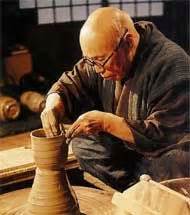
After college I moved back to rural NH to begin an apprenticeship at a local pottery studio that made traditional items like ginger jars, crocks, kitchen and table ware. In exchange for cleaning the studio, prepping the clay, mixing glazes, feeding the chickens, I was permitted to live in the room above the studio in the barn and in my spare time make my own pottery. There was a small roadside shop attached to the pottery where I could set my wares out for sale. I made a lot of pots with primitive chicken motifs on them. Showers in the house cost $1 (cheap old Yankee!) so I swam daily that summer in the nearby lake with my Dr. Bronner’s soap. My friend Sandy, a pastel artist, lived at the top of the mountain in shack by a bog and we often ate homegrown kohlrabi soup made with goats milk, leeks and duck eggs from her garden and critters. Mostly broke, idealistic and happy. A simple life, sans-souci.
Old Home Days in that small town was my first craft fair experience. I paid my $7, set up 2 boards on 4 concrete blocks, put an Indian rug down and sat there on the ground playing my autoharp in the New Hampshire summer sun. I traded a mixing bowl set I’d made for a handwoven poncho, made from the wool of the sheep the weaver raised, shorn, and dyed with local plant dyes. I earned $120 that day and went home with a beautiful poncho. That was 1980. I still have that poncho. It was a time of joyful engagement in creative ideas and perhaps naïveté, when the aesthetics of the inseparability of the life lived and the work produced was paramount. No-one used the term “artisanal” or “authentic”.
Traditional Buddhist practice was often about living a sequestered life in a monastery, nunnery, remote hut on a faraway mountain or a cave, far from the troubles and distractions of “the world of red dust”, the common world. But most of us do not live that life. Recently I have been listening to many folks, thoughtful and sensitive people, express their grief, confusion and fears over the state of the world, its wars, politics, climate crisis, poverty and violence and the future. These are heartfelt concerns we have for the fates of one another, our children and ourselves. There is a feeling of the inability to affect meaningful change, unable to make a difference, a deep sense of powerlessness. The news of the world can become a dark addiction to suffering.
We are part of this red dust world and so, as awakened beings, we acutely experience this suffering. During a sesshin during Rohatsu in Colorado Springs I went to Myoshin Sensei in tears, simply brokenhearted for the state of all beings and shared my feeling with her. She said; “To be enlightened is to live with suffering.” Ours is not a practice that turns us away.
I often long for a simple life, free of the complicated and compounded worries and frustrations of this age and what seems like an increasingly complicated society that by the year becomes more vacuous and more difficult to thrive in. And yet I realize that my worries, suffering and problems are of my own making. It is no other than my mind that plays these games and focuses on the problem rather than the solution. I am the only one who focuses my magnifying mind on the problems and complications of all that appears as separate from myself and troublesome. Clearly one cannot focus only on the credulous thinking that ‘the world is fine’, circling one’s own navel in manufactured, delusional, ignorant bliss. The true-fact is this; the world is as it is, no more, no less. When I recall what actually made my life free, it was simplicity. Yes, there were the troubles of the times, as there always have been and will be, but there was a deep un-self-conconscious engagement in natural-being, in my work-life-hearth-home-art.
In order to begin re-imaging and create that simplicity in life, what must be recalled are the heart-to-hand-to-heart connections of our essential humanity. We must re-engage with a directness, a transformative confidence born from curiosity and wonder in our practice, our daily work, our relationships and the Earth. A handmade life connects us to one another. A handmade life is a life consciously built in balance and value. A handmade life is built by not defaulting to our base nature that is so easy and attractive. It is not manufactured by false hope, not made in anger or desperation or otherness, but by actually looking deeply into ourselves and loving what we find, because ofour imperfections. In the handmade aesthetic, the mark of the maker’s hand is considered a valuable asset to the finished piece. Often recognized as an imperfection, a slip of hand or tool or an overlooked fingerprint of sorts. It is considered the roadmap of the creation, a heart-line in the connection of maker and made.
Honoring that simple connection, that mark and roadmap within ourselves creates unity. This transforms us into the simplicity that we seek, our connection in a nonverbal, deeply primal and essential way, tying together the fundamental transformation of the raw materials of being, both physical and humanistically spiritually and in that rudimentary alchemy we become in our unity, greater than our individuality.
The simple life can only be of my own making. It requires me to engage lightly with natural joys and sorrows, as they arise and to hold them loosely. It requires an effort on my part at being joyfully engaged and nurturing the practice of inseparability, compassion and engaged-wisdom. This is a gift of our practice.
It’s easy enough to fall prey to the collective existential angst of our world and call it horrible, become worried, fearful and depressed, but that’s the default, that has always been the unenlightened shadow cast down through the ages of humanity. We each choose how we view the turning of the wheel of dharma, and how we engage with it. We practitioners of meditation have a unique insight into the reality of being and how we can be creatively engaged with this turning.
Returning to the simplicity of ourselves is a great gift that resonates throughout time and space to all beings. I feel a strong desire, a need to redouble my work at the integration of simplicity. The purpose of our practice is no less than this for our own benefit and that of all beings.
Deep peace and great love, Issan (author) & Zenho, from Nepal!
SCHEDULE 10/21-11/4
MONDAY, 6:30 AM, ZAZEN AT THE TEAHOUSE, SOKOUKAI OPENING
TUESDAY, 6:30 AM, ZAZEN AT THE TEAHOUSE, ANDY OPENING
WEDNESDAY, 6:30 AM, ZAZEN AT THE TEAHOUSE, ANDY OPENING
THURSDAY, 6:30 AM, ZAZEN AT THE TEAHOUSE, DOKUSAN WITH ISSAN SENSEI
This time of year is like a portal. From the frenzied energy of summer, where plants and animals play out their life cycles of output, to summer vacations and tending gardens…to the transition to falling leaves, darkening mornings nudging the wearing of warm socks and layers…to the slow, yet deliberate move into dormancy. To quieting down. To introspection. The coming into the landscape of inner worlds…
For many humans throughout time, this season change comes with a time of reverence and honoring of the dead. The Aztec, Toltec and Mayans set aside a month to celebrate the dead thousands of years before colonialism. All Hallow’s Eve and All Saints Day originated from an ancient Celtic festival called “Samhain” over 2,000 years ago. It is believed that the boundary between the living and the dead is blurred during this time – the veil between the earthly plane and the spiritual world is thin.
In my personal experience, my first deep encounter with death arrived this time of year. My dad was killed by a drunk driver while he was on the job delivering produce on October 30th, 2001. I was 12 and in 7th grade. A sudden severing that has, put simply, defined me.
I remember telling my family I wanted to go to school the next day, it was Halloween. I wanted things to be normal. In first period science class, my teacher was dressed up as a truck driver (and my mind went to: my dad drove a produce truck). And his costumed truck said “Mac” on the front (and my mind went to: that’s the name of our late family dog and short for my last name McClintock). As the class went on, I remember feeling heat build, embarrassment build, do others know? Are they looking at me? Is this some sort of sick joke? The grief went from a simmer to an all out rolling boil inside of me as the shock of the loss began to sink in as reality and I realized…I can’t be here. I sat through the rest of class holding back the desire to run out, cry and wail – so self-conscious of how everyone would see me. I went home after that class and didn’t go back for several weeks.
Today, when I reflect back on that moment and the years following – being an emotionally under-resourced teenager navigating the loss of their stable parent and being cared for by emotionally under-resourced adults. The embarrassment of having to explain where your dad was – to parents in volleyball carpools, to teachers, to new friends. Not being able to do it without crying. It made people uncomfortable. Best to appear strong and over it. To “sunshine” one’s way through the grief. See the silver linings. Tears well when I think of this suppression and I give that young person a big hug.
It wasn’t until college, when my high school friend overdosed on October 30th 2008, that I was strongly invited to meet my grief again. Insomnia. Spontaneous solo night hikes. Binge drinking. Binge eating. The ripening of something that needed attention.
During college, I was introduced to Buddhism. I began looking inward. I then moved to Montana for grad school. I began to understand myself in nature. I began to intuitively process the unmetabolized grief of losing my dad and friend through ritual.
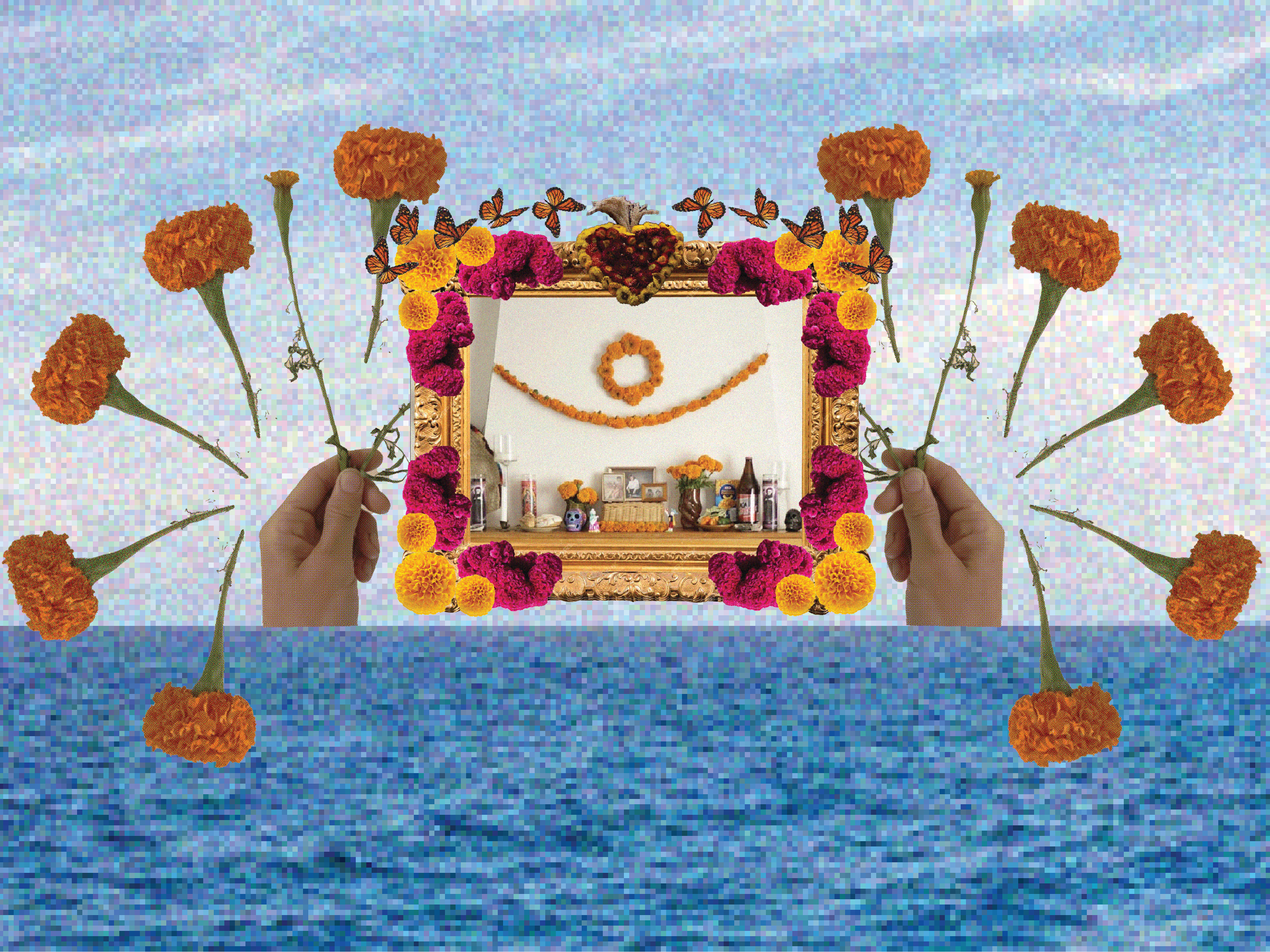
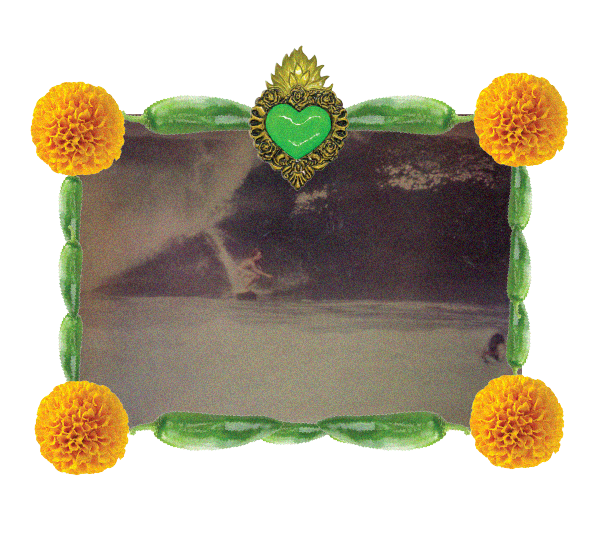
My dad spent a chunk of time in his 20s in Oaxaca as a dirt bagging surfer. It is one of my family’s favorite character narratives – as he ran out of money, and had to accept help from a Mexican family to eat and eventually get back home to California. He loved everything about Mexico. Since he died at the same time as the annual Dia de los Muertos celebrations in Mexico, I’ve naturally gravitated to this holiday. I began making altars. I cried. I shared. And over the years that led to sharing this time with others, to hosting Day of the Dead potlucks and inviting others to contribute to a shared altar and remember their beloveds too.
Four years ago, I woke up struck that my dad’s artwork wasn’t archived. I cataloged all of his art and made him a website. A hard year may mean a day of running in the mountains on his death day. All of these actions have come from an unspoken internal place. As I began to be more intimate with my internal landscape through meditation, accepting support, working with dreams, writing, time in nature, psychedelics, movement…I can see now that I am tapping into my own well for healing. Listening to my heart-mind-body and its affinities towards certain things. The grief process is individual. It’s spiraling. Looking more like a tangled, stretched-out slinky, than linear. Even 22 years later, I still sometimes hit the edges that push me into a limbic trance. I now allow myself to be in the darkness when it comes. Abiding and moving through it. Still sucks though.
I offer this rawness, while the veil is thin, because I know that each person has their own deep relationship with loss and grief. Individually and collectively. And right now there is a great loss of human life and profound collective heartbreak.
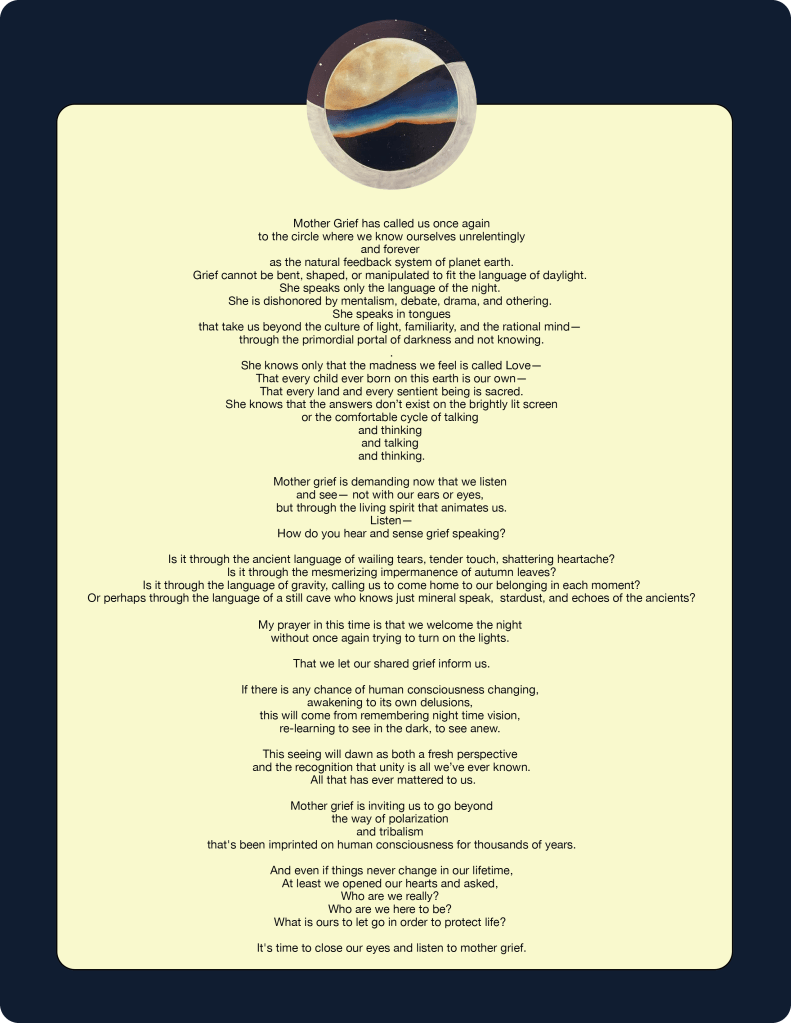
In this darkness, Deborah Eden Tull, engaged dharma teacher and author offers us these potent words:
Honoring the darkness in all of us,
Madison/Sokukai. (Words and Collages).
Schedule October 23-29
Zenho out of town until 11/3 or so.
Monday: 6:30 AM ZAZEN at the Teahouse, Sokukai opening.
Tuesday: 6:30 AM ZAZEN at the Teahouse, Sokukai opening.
Wednesday: 6:30 AM ZAZEN at the Teahouse, Andy opening.
Thursday: 6:30 AM, ZAZEN and DOKUSAN at the Teahouse with ISSAN SENSEI
Friday: 6:30 AM, ZAZEN at the Teahouse, Mugen opening.
Please remember: ZAZENKAI and COUNCIL: DECEMBER 1,2 & 3.
Noah’s Poem:
I awoke to the laughter of birds this morning Snuggled tightly into my tent They were out playing Looping around in their joy As the World Mind Looped around this ancient Project of Projection Of “isms” and schisms and “ists” and fists and Dizzying swirls And Points of view That are Not You












 No Gate Zen Center