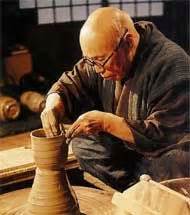
After college I moved back to rural NH to begin an apprenticeship at a local pottery studio that made traditional items like ginger jars, crocks, kitchen and table ware.
In exchange for cleaning the studio, prepping the clay, mixing glazes, feeding the chickens, I was permitted to live in the room above the studio in the barn and in my spare time make my own pottery. There was a small roadside shop attached to the pottery where I could set my wares out for sale. I made a lot of pots with primitive chicken motifs on them.
Showers in the house cost $1 (cheap old Yankee!) so I swam daily that summer in the nearby lake with my Dr. Bronner’s soap.
My friend Sandy, a pastel artist, lived at the top of the mountain in shack by a bog and we often ate homegrown kohlrabi soup made with goats milk, leeks and duck eggs from her garden and critters.
Mostly broke, idealistic and happy. A simple life, sans-souci.
Old Home Days in that small town was my first craft fair experience. I paid my $7, set up 2 boards on 4 concrete blocks, put an Indian rug down and sat there on the ground playing my autoharp in the New Hampshire summer sun. I traded a mixing bowl set I’d made for a handwoven poncho, made from the wool of the sheep the weaver raised, shorn, and dyed with local plant dyes. I earned $120 that day and went home with a beautiful poncho. That was 1980. I still have that poncho. It was a time of joyful engagement in creative ideas and perhaps naïveté, when the aesthetics of the inseparability of the life lived and the work produced was paramount. No-one used the term “artisanal” or “authentic”.
Traditional Buddhist practice was often about living a sequestered life in a monastery, nunnery, remote hut on a faraway mountain or a cave, far from the troubles and distractions of “the world of red dust”, the common world. But most of us do not live that life. Recently I have been listening to many folks, thoughtful and sensitive people, express their grief, confusion and fears over the state of the world, its wars, politics, climate crisis, poverty and violence and the future. These are heartfelt concerns we have for the fates of one another, our children and ourselves. There is a feeling of the inability to affect meaningful change, unable to make a difference, a deep sense of powerlessness. The news of the world can become a dark addiction to suffering.
We are part of this red dust world and so, as awakened beings, we acutely experience this suffering. During a sesshin during Rohatsu in Colorado Springs I went to Myoshin Sensei in tears, simply brokenhearted for the state of all beings and shared my feeling with her. She said; “To be enlightened is to live with suffering.” Ours is not a practice that turns us away.
I often long for a simple life, free of the complicated and compounded worries and frustrations of this age and what seems like an increasingly complicated society that by the year becomes more vacuous and more difficult to thrive in. And yet I realize that my worries, suffering and problems are of my own making. It is no other than my mind that plays these games and focuses on the problem rather than the solution. I am the only one who focuses my magnifying mind on the problems and complications of all that appears as separate from myself and troublesome. Clearly one cannot focus only on the credulous thinking that ‘the world is fine’, circling one’s own navel in manufactured, delusional, ignorant bliss. The true-fact is this; the world is as it is, no more, no less. When I recall what actually made my life free, it was simplicity. Yes, there were the troubles of the times, as there always have been and will be, but there was a deep un-self-conconscious engagement in natural-being, in my work-life-hearth-home-art.
In order to begin re-imaging and create that simplicity in life, what must be recalled are the heart-to-hand-to-heart connections of our essential humanity. We must re-engage with a directness, a transformative confidence born from curiosity and wonder in our practice, our daily work, our relationships and the Earth. A handmade life connects us to one another. A handmade life is a life consciously built in balance and value. A handmade life is built by not defaulting to our base nature that is so easy and attractive. It is not manufactured by false hope, not made in anger or desperation or otherness, but by actually looking deeply into ourselves and loving what we find, because of our imperfections. In the handmade aesthetic, the mark of the maker’s hand is considered a valuable asset to the finished piece. Often recognized as an imperfection, a slip of hand or tool or an overlooked fingerprint of sorts. It is considered the roadmap of the creation, a heart-line in the connection of maker and made.
Honoring that simple connection, that mark and roadmap within ourselves creates unity. This transforms us into the simplicity that we seek, our connection in a nonverbal, deeply primal and essential way, tying together the fundamental transformation of the raw materials of being, both physical and humanistically spiritually and in that rudimentary alchemy we become in our unity, greater than our individuality.
The simple life can only be of my own making. It requires me to engage lightly with natural joys and sorrows, as they arise and to hold them loosely. It requires an effort on my part at being joyfully engaged and nurturing the practice of inseparability, compassion and engaged-wisdom. This is a gift of our practice.
It’s easy enough to fall prey to the collective existential angst of our world and call it horrible, become worried, fearful and depressed, but that’s the default, that has always been the unenlightened shadow cast down through the ages of humanity. We each choose how we view the turning of the wheel of dharma, and how we engage with it. We practitioners of meditation have a unique insight into the reality of being and how we can be creatively engaged with this turning.
Returning to the simplicity of ourselves is a great gift that resonates throughout time and space to all beings. I feel a strong desire, a need to redouble my work at the integration of simplicity. The purpose of our practice is no less than this for our own benefit and that of all beings.

Deep peace and great love, Issan (author) & Zenho, from Nepal!
SCHEDULE 10/21-11/4
MONDAY, 6:30 AM, ZAZEN AT THE TEAHOUSE, SOKOUKAI OPENING
TUESDAY, 6:30 AM, ZAZEN AT THE TEAHOUSE, ANDY OPENING
WEDNESDAY, 6:30 AM, ZAZEN AT THE TEAHOUSE, ANDY OPENING
THURSDAY, 6:30 AM, ZAZEN AT THE TEAHOUSE, DOKUSAN WITH ISSAN SENSEI
FRIDAY, ZAZAEN AT THE TEAHOUSE, ANDY OPENING
ZAZENKAI AND COUNCIL DEC. 1-3
Noah’s Poem
Chilly intimations of that
Season of Nostalgia
Impressions of a childhood
A dusty box of
Long forgotten feelings
Beckons me
Lightly brushes my bare shoulders as I
Twist this creaking doorknob
Do you remember what it was like?
Not the nostalgia
But the consciousness
Holding your best friend’s hand after school
Your mother tending to your bruised knee
Playing with your brother
In the bath
 No Gate Zen Center